Overview
Week 16 marks the culmination of an entire semester's research, experimentation, and prototyping. This final week brought together all accumulated materials visual artifacts, synthesized audio, field research, and technical exploration into three distinct deliverables: an Audio-Reactive Particle Simulator, comprehensive presentation slides, the Creative Process Journal, and a digital noise catalog pamphlet.
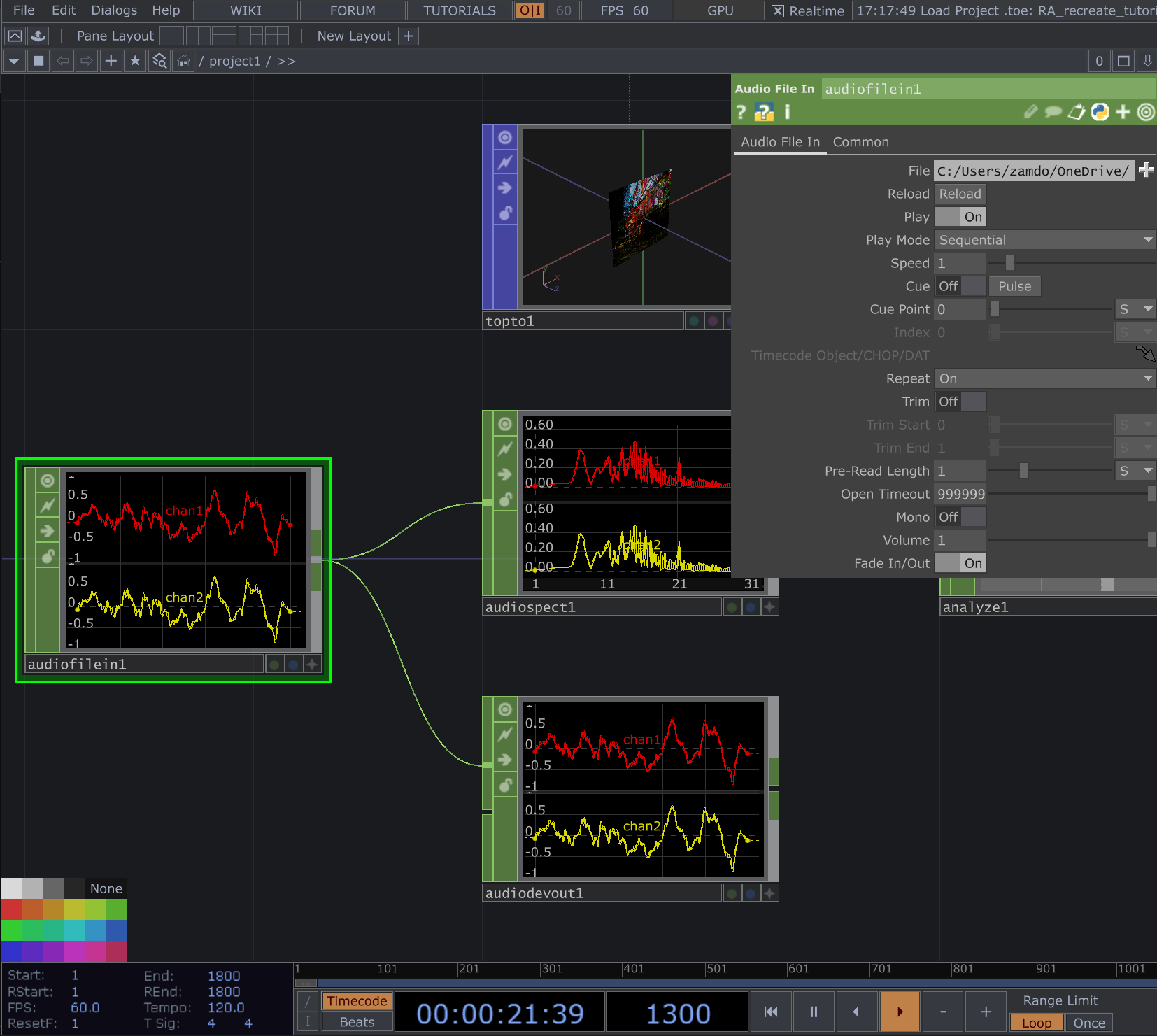
The centerpiece of this week's work is a real-time TouchDesigner-based prototype that transforms the semester's noise documentation into dynamic, responsive generative artwork. By extracting color palettes from the 13 district visual artifacts and connecting them to audio spectrum analysis nodes, the system creates fluid, abstract compositions that respond in real-time to each location's synthesized noise recordings.
Beyond the interactive prototype, this week involved the critical work of archiving and documentation consolidating months of research into structured formats that communicate the project's evolution, findings, and conceptual framework to external audiences.
Audio-Reactive Particle Simulator: Real-Time Noise Visualization
The Audio-Reactive Particle Simulator represents the final synthesis of the semester's work, transforming static visual artifacts and audio recordings into dynamic, generative experiences. Built in TouchDesigner, this real-time system creates abstract particle compositions that respond directly to the acoustic characteristics of each documented district.
Technical Development Process
The development process involved several interconnected stages, each building upon the visual and sonic materials created throughout the semester:
1. Color Palette Extraction from Visual Artifacts
Each of the 13 district visual artifacts created in Week 15 served as the foundation for color extraction. The composited images already embodying each location's sonic character through photographic synthesis were analyzed to identify dominant color palettes representing different noise zones and acoustic qualities.
These color palettes became the visual language through which sound would be rendered in real-time. Rather than arbitrary color choices, each hue carries the visual DNA of its corresponding district's noise landscape.
2. Audio Spectrum Analysis Integration
The synthesized audio recordings created for each district were connected to TouchDesigner's audio spectrum analysis nodes. These nodes break down the complex audio signals into frequency bands, allowing different sonic characteristics bass frequencies, mid-range tones, high-frequency content to control distinct visual parameters.
By mapping spectral data to particle behavior, color intensity, movement patterns, and spatial distribution, the system translates invisible acoustic properties into visible, dynamic forms.
3. Real-Time Generative Rendering
The final system operates in real-time, continuously generating particle compositions that respond fluidly to audio input. As each district's noise recording plays, particles emerge, move, cluster, and disperse according to the moment-to-moment variations in the sonic landscape.
The result is abstract yet powerfully evocative viewers experience each location's acoustic character through movement, color, density, and rhythm, creating an immersive visualization that makes noise perceptible in entirely new ways.
District Particle Visualizations
The following videos demonstrate the Audio-Reactive Particle Simulator responding to each of the 13 documented districts. Each visualization reveals the unique sonic character of its location through real-time particle behavior, color dynamics, and movement patterns derived directly from the area's synthesized noise recordings.
Bugis
Bukit Panjang
Buona Vista
Changi Airport
Chinatown
City Hall
Haji Lane
Jurong West
Marina Bay
Orchard
Raffles Place
Sentosa
Tanjong Pagar
Technical Challenges & Design Solutions
The Challenge of Sonic Differentiation
One significant challenge emerged during development: achieving clear visual differentiation between districts based on their unique sonic characteristics. While the conceptual goal was for each location's particle behavior to distinctly reflect its specific noise profile, the technical complexity of this ambition exceeded available time and expertise.
Professional-grade audio-reactive systems employ sophisticated spectral analysis, machine learning classification, and complex parameter mapping to achieve highly nuanced responses to sonic variations. Replicating this level of detail and precision requires specialized technical knowledge and extensive development time resources not fully available within the project timeline.
The result was that while each district's visualization responded to its audio, the degree of perceptible difference between visualizations was less pronounced than initially envisioned. Viewers might struggle to immediately recognize distinct locations based solely on particle behavior without additional contextual information.
Supplementary Color Spectrum Documentation
To address this limitation, supplementary color spectrum documentation was integrated into the Noise Pollution Pamphlet. Each district entry includes a visual color palette extracted from its visual artifact, serving as a reference key that helps viewers understand the relationship between specific colors and specific locations.
This approach transforms a technical limitation into a design opportunity: rather than expecting the particle system alone to communicate all information, the pamphlet provides contextual support that enhances comprehension. Viewers can reference the color spectrums while experiencing the real-time visualizations, creating a multi-layered understanding of each district's sonic identity.
This solution reflects an important design principle: when technical systems cannot achieve perfect clarity on their own, thoughtful supplementary documentation can bridge the gap, creating more accessible and meaningful experiences for audiences.
Development Progress Documentation
The following videos document the iterative development process of the Audio-Reactive Particle Simulator, showing the evolution from initial experiments to the final system. These progress captures reveal the technical refinement and design decisions that shaped the final prototype.
Development Stage 1: Initial Audio Analysis Integration
Development Stage 2: Color Palette Application
Development Stage 3: Particle Behavior Refinement
Project Archiving: Documentation & Presentation
Beyond creating the final interactive prototype, Week 16 involved comprehensive archiving of the entire semester's work. This archiving process transformed dispersed research materials, experiments, prototypes, and reflections into structured documentation formats suitable for presentation, review, and future reference.
Presentation Slides
A comprehensive slide deck was created to communicate the project's conceptual framework, research methodology, key findings, and prototype outcomes to faculty and peers. The slides synthesize complex processes into clear visual narratives, using diagrams, photographs, screenshots, and concise text to convey the project's evolution from initial concept to final deliverables.
The slide structure follows the semester's chronological progression while highlighting key turning points, critical decisions, and iterative refinements that shaped the final work.
Creative Process Journal (CPJ)
This website serves as the Creative Process Journal, documenting every week's activities, experiments, reflections, and outcomes. The CPJ format allows for detailed, multimodal documentation that includes text analysis, image galleries, embedded audio/video, and interactive prototypes.
Unlike the condensed presentation slides, the CPJ preserves the full complexity and nuance of the research process, including failed experiments, revised approaches, and evolving conceptual understanding. It functions as both a personal research archive and a public-facing portfolio demonstrating rigorous design research methodology.
Digital Noise Catalog Pamphlet
The Noise Pollution Catalog represents a curated subset of the project's findings, designed for broader public engagement. This digital catalog integrates visual artifacts, audio experiences, spectral analysis, and location information into a cohesive reading experience optimized for mobile devices.
Each district entry provides environmental context, sonic analysis, visual representation, and audio access, creating a comprehensive yet accessible introduction to Singapore's acoustic landscape. The pamphlet demonstrates how extensive research can be distilled into engaging public-facing documentation that invites exploration rather than overwhelming viewers with technical complexity.
The inclusion of color spectrum references directly addresses the particle simulator's limitation, ensuring that the pamphlet and the interactive prototype function as complementary experiences rather than standalone artifacts.
Reflection: From Concept to Completion
Week 16 represents not just the completion of a final prototype, but the culmination of an entire semester's research journey from initial explorations of noise as aesthetic material, through field documentation across 13 Singapore districts, experimental AI-generated imagery (ultimately rejected), systematic visual artifact creation, audio synthesis, 3D interactive mapping, and finally, real-time generative visualization.
Each week's work built upon previous discoveries, with failures and limitations often proving as valuable as successes in refining the project's direction. The decision to reject AI-generated imagery in favor of authentic field documentation, the development of composite photographic artifacts, and the integration of audio-reactive visualization all emerged through iterative experimentation and critical reflection.
The final deliverables the Audio-Reactive Particle Simulator, comprehensive presentation, CPJ documentation, and digital catalog demonstrate multiple approaches to the same core question: how can design transform noise from pollution into aesthetic experience? Each format addresses different audiences and contexts, from academic presentation to public engagement to personal research archive.
The semester's work validates the central hypothesis: when approached with rigorous methodology, creative experimentation, and thoughtful design, urban noise reveals aesthetic qualities, spatial characteristics, and experiential richness that challenge its dismissal as mere environmental nuisance. Noise, properly documented and artfully presented, becomes a medium for understanding cities, cultures, and the complex sonic landscapes that shape daily life.
Final Outcomes
Week 16's completion of the Audio-Reactive Particle Simulator and comprehensive project archiving achieved several critical outcomes:
- Successfully synthesized all semester materials into real-time generative visualization system
- Created 13 district-specific audio-reactive particle compositions demonstrating sonic diversity
- Developed supplementary color spectrum documentation to enhance viewer comprehension
- Completed comprehensive presentation slides communicating research methodology and findings
- Maintained detailed Creative Process Journal documenting entire research evolution
- Designed accessible digital catalog pamphlet for public engagement with noise research
- Demonstrated how technical limitations can be addressed through thoughtful supplementary design
- Validated multi-format documentation approach serving different audiences and contexts
These deliverables collectively demonstrate that noise when rigorously documented, creatively visualized, and thoughtfully presented transforms from pollution into rich aesthetic material worthy of sustained attention, analysis, and appreciation.
Looking Forward
The semester's work establishes a foundation for potential future development:
- Successfully merge the three research pillars (Embodied Interaction, Turning Noise into Art, Sculpting Shape of Noise) into one unified prototype
- Collect noise pollution data from at least 30+ locations across Singapore
- Create visually stronger and more three-dimensional prototype
- Deepen dissertation research with more detailed exploration to strengthen the paper's coherence, validity, and overall foundation
The project demonstrates that noise research sits at the intersection of design, technology, urban studies, and aesthetics a rich territory for continued exploration and development.