Overview
This week marked a critical turning point in establishing the conceptual foundation for the project. Through intensive mind-mapping and strategic planning, I defined the core problem and established a clear project direction that would guide all future development.
The central challenge was determining the project's fundamental approach: Should noise be treated as pollution to be reduced, or as raw material to be sculpted? This decision would define the entire trajectory of the research.
Goal & Process
Goal
To define the core problem and establish a clear project direction that would serve as the foundation for all subsequent research and development. The goal was not just to identify what to create, but why it matters and how it contributes to the field of design communication.
Process
Conducted an intensive mind-mapping session to analyze the characteristics of noise from multiple perspectives. We debated between a 'Problem-Solving' approach versus an 'Experimental Challenge' approach, weighing the merits of each framework and their implications for the final outcome.
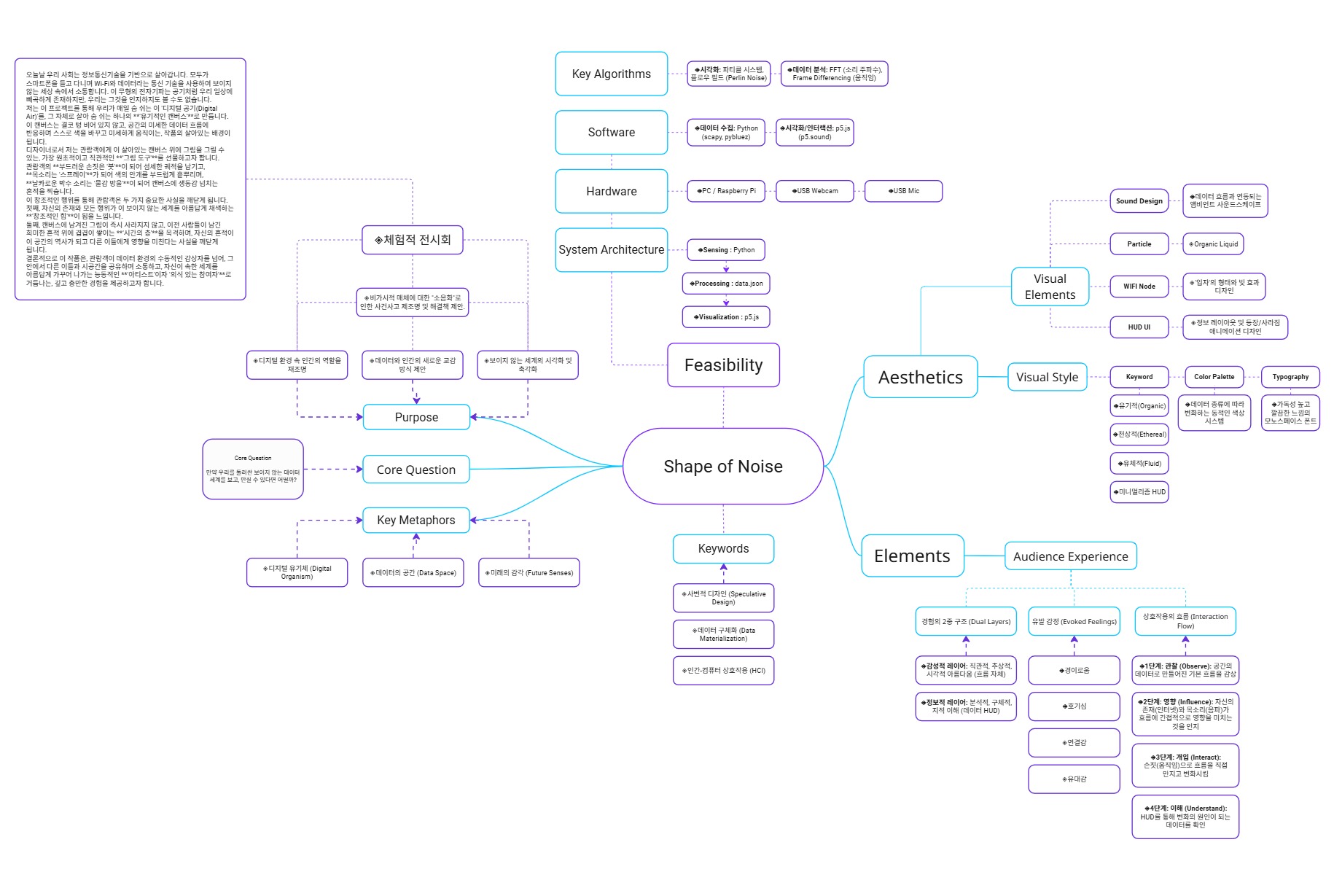
Initial brainstorming session: Mapping the characteristics of noise
Challenges & Solution
Challenge
The primary challenge was deciding whether to treat noise as pollution to be reduced or a material to be sculpted. This wasn't merely an academic questionit fundamentally shaped the project's identity, methodology, and potential impact. A problem-solving approach would focus on mitigation and reduction, while an experimental approach would embrace noise as creative medium.
Solution
After extensive deliberation, I decided on an 'Experimental Challenge' approach: to visualize the invisible. Rather than treating noise as something to eliminate, the project would explore it as an artistic materialtransforming urban soundscapes into immersive, interactive visual experiences. This decision set a clear milestone and philosophical foundation for the project.
Outcome
Successfully completed the Project Roadmap and Concept Mind Map. These documents serve as the strategic foundation for the entire graduation project, providing clarity on objectives, methodology, and expected deliverables. The roadmap outlines key milestones from conceptualization through technical validation to final exhibition.
The mind map revealed critical connections between embodied interaction, sensory translation, and aesthetic transformationthree pillars that would become central to the project's theoretical framework.
Next Steps
With the conceptual framework established, the next phase focuses on technical feasibility and prototyping. Key questions to address include:
- What tools are most suitable for volumetric visualization?
- How can 1D audio data be translated into intuitive 3D visual representations?
- What technical constraints need to be considered for real-time interactivity?